
Texas Motorcycle Helmet Law: Who Must Wear One & How It Affects Your Claim

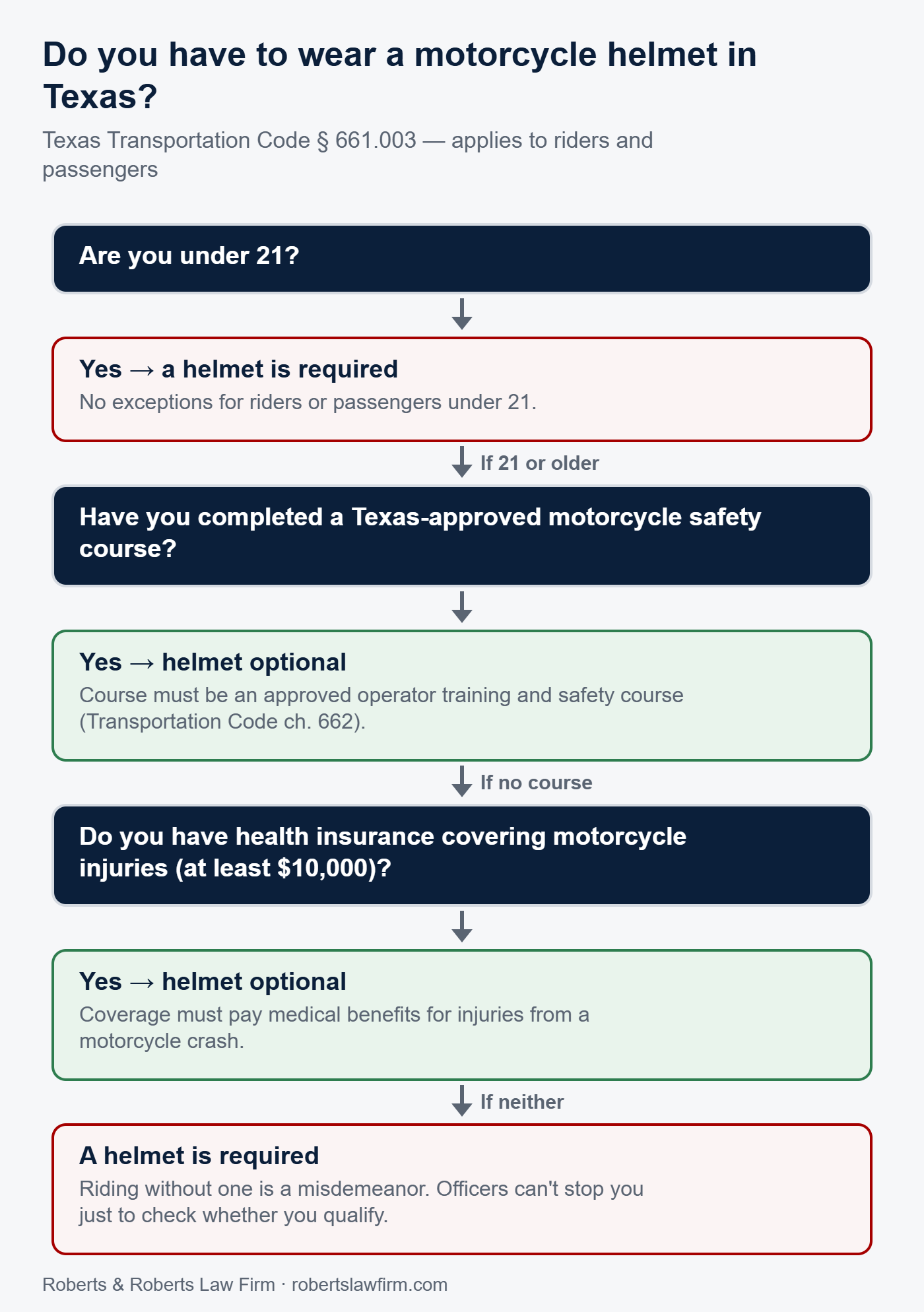
Texas is a "partial" helmet law state. Motorcycle riders under 21 must wear a helmet. Riders 21 and older can legally ride without a helmet — but only if they've completed an approved safety course or carry qualifying health insurance.
That sounds simple, but helmet use comes up in almost every serious motorcycle injury case we handle. Here's what the Texas motorcycle helmet law says, how it affects an injury claim, and what the numbers show.
100% Free Consultation
The short version
- Under 21: helmet required, rider or passenger.
- 21 and older: helmet optional if you've completed an approved motorcycle safety course or have health insurance covering at least $10,000 in motorcycle-crash injuries.
- Police can't pull you over just to check whether you qualify for the exemption.
- Not wearing a helmet doesn't mean you caused the crash. But the other side may argue it made your injuries worse.
What the Texas helmet law actually says
What counts as a "helmet"?
The law requires headgear that meets the federal motorcycle helmet standard (FMVSS No. 218). You can find a marking on your helmet that confirms it meets U.S. Department of Transportation (DoT) standards. Typically, thin "novelty" helmets don't meet it, and in any event, in a crash they offer little protection.
Does not wearing a helmet hurt my injury claim?
It can, but less than most riders fear. Here's how it usually plays out:
| Question | How it usually goes |
|---|---|
| Who caused the crash? | Helmet use has nothing to do with it. A driver who turned left in front of you is responsible for the crash either way. |
| Did no helmet make the injuries worse? | The defense may argue it did — mainly for head and brain injuries. They usually need medical or engineering proof. |
| Injuries a helmet wouldn't prevent | Broken legs, road rash, spinal and internal injuries — a helmet argument shouldn't touch these. |
| Effect on recovery | Texas compares fault. If a jury assigns you some responsibility, your damages are reduced by that percentage — and barred only if you're over 50% responsible. |
Texas courts have allowed similar "failure to mitigate" evidence about seatbelts when there's proof it actually affected the injuries (Nabors Well Services v. Romero, 2015). Expect insurers to try the same approach with helmets, and expect a fight over the proof. We cover this in more detail in what percentage of motorcycle accidents are the rider's fault?
From our files: We've represented riders on both sides of the helmet question. In one case, our client's helmet stayed on as he tumbled across the pavement, and we moved quickly to secure the motorcycle and his gear before anything was repaired or salvaged.
In another, the rider wasn't wearing a helmet at all. The case still turned on what it should have: a pickup towing a trailer that pulled into his path. The fact that the biker wasn't wearing a helmet didn't change who caused the crash.
Proving your exemption
If you ride without a helmet, keep proof of legal compliance with you: your course completion card and your health insurance card. In an injury case, being legally exempt helps rebut the argument that you were breaking the law — even though the injury-causation question can still come up.
Why bias against riders matters
Jurors and adjusters sometimes unfairly assume that motorcyclists are reckless. The data, however, doesn't back that up: in many multi-vehicle motorcycle crashes, the other driver is usually at fault — often because they didn't see the motorcycle. A good case shows the jury exactly what the other driver could and should have seen, including sight lines, speed, timing, so helmet use doesn't become a distraction from who caused the wreck.
Frequently asked questions
Do passengers have to wear helmets in Texas?
The same rules apply. Passengers under 21 must wear one; passengers 21 and older need the course or the insurance exemption.
Can I get a ticket for not wearing a helmet?
Yes, if you don't qualify for an exemption. But Texas law says an officer can't stop or detain you solely to check whether you qualify.
Does Texas require eye protection or a windshield?
Texas's helmet statute doesn't add an eye-protection requirement. Check current law and your bike's equipment rules, and wear eye protection anyway — bugs and debris cause crashes.
Will my health insurance pay if I wasn't wearing a helmet?
Health plans generally pay according to their terms. If they pay your bills, they may claim reimbursement from your injury settlement.
Hurt in a motorcycle crash — helmet or not?
Don't let an insurance company use helmet use to shortchange you. Free consultation; no fee unless we recover. Call (800) 248-6000.
About The Author

- Tex. Transp. Code § 661.003 (protective headgear; exemptions).
- Texas Department of Transportation, Texas Motor Vehicle Traffic Crash Facts, Calendar Year 2024.
- Nabors Well Services v. Romero, 456 S.W.3d 553 (Tex. 2015); Tex. Civ. Prac. & Rem. Code ch. 33 (proportionate responsibility).