
Who Can File a Wrongful Death Lawsuit in Texas?

When a family loses someone because of another person's carelessness, one of the first legal questions we get is: who has the right to bring a claim against the wrongdoer? Texas law gives a limited and specific answer.
Texas law allows only three groups of family members to file a Texas wrongful death lawsuit. Here's who they are, who is left out, what happens when nobody files, and how a separate "survival" claim fits in.
100% Free Consultation
The short version
- Only the surviving spouse, children, and parents can bring a Texas wrongful death claim.
- They can file together or separately, and one can file on behalf of all of them.
- Siblings, grandparents, grandchildren, and stepchildren who weren't adopted can't file a wrongful death claim.
- If no eligible family member files within three months, the estate's executor or administrator must file — unless all eligible family members ask them not to.
- The deadline is generally two years from the date of death.
Who can file: the Texas wrongful death statute
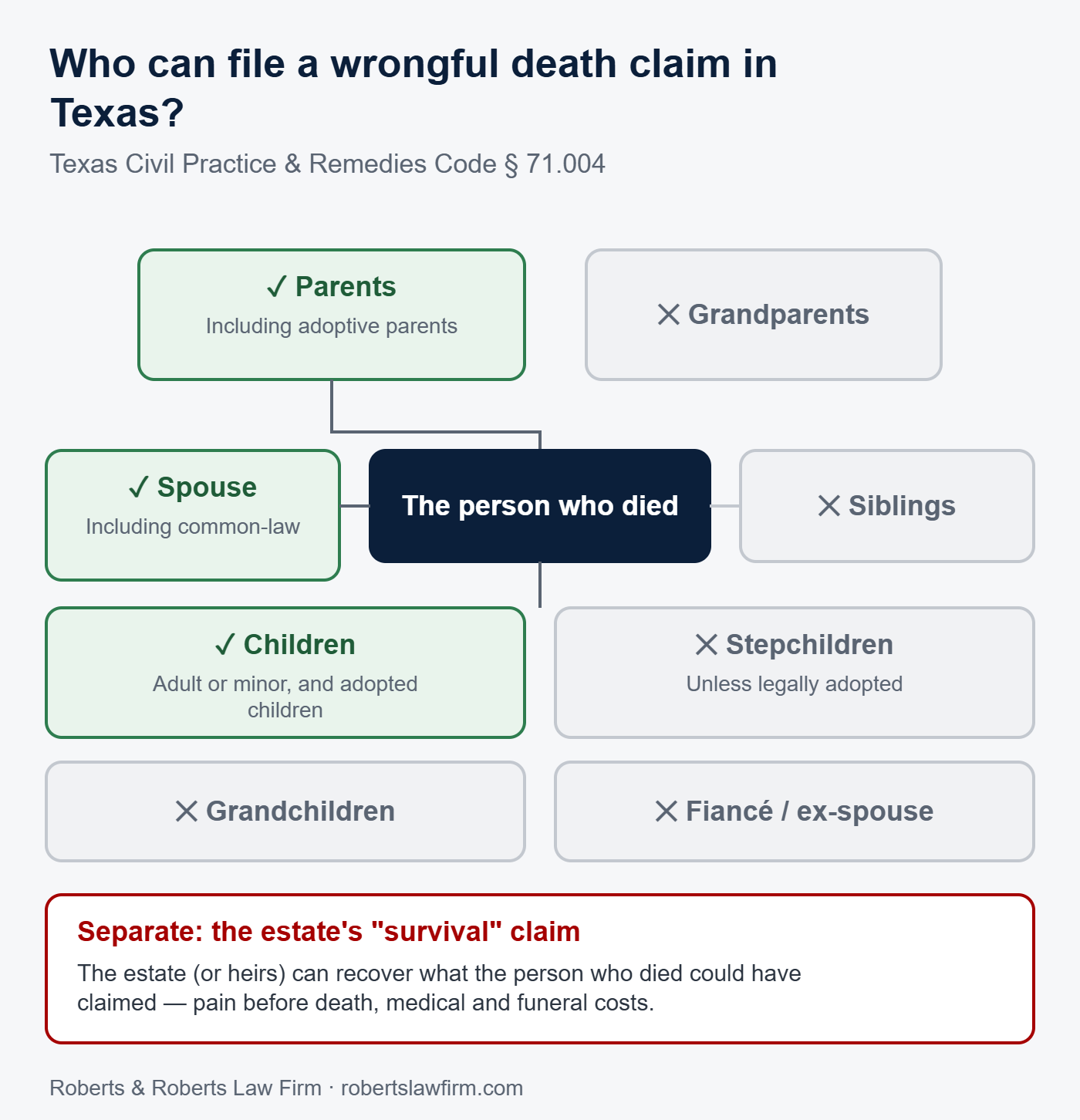
| Family member | Can file? | Notes |
|---|---|---|
| Spouse | Yes | Includes a common-law (informal) spouse if the marriage can be proven. A divorced ex-spouse can't. |
| Children | Yes | Adult and minor children, and legally adopted children. |
| Parents | Yes | Including adoptive parents — even when the person who died was an adult. |
| Siblings | No | Even if they were the closest family. |
| Grandparents / grandchildren | No | A grandchild may share in the estate's survival claim. |
| Stepchildren / stepparents | No | Unless there was a legal adoption. |
| Fiancé or partner | No | Unless an informal marriage can be proven. |
What if no one files?
If none of the eligible family members files within three calendar months of the death, the executor or administrator of the estate is required to bring the case for the family's benefit — unless all of those family members ask that it not be filed. In practice, families usually choose which family member will take the lead and hire one lawyer to represent everyone's interests.
Wrongful death vs. survival claims
| Wrongful death claim | Survival claim | |
|---|---|---|
| Whose loss? | The family's — loss of companionship, support, inheritance, and their grief | The person who died — what they could have sued for if they'd lived |
| Who brings it? | Spouse, children, parents | The estate's legal representative (or heirs, in some cases) |
| Examples of damages | Lost earnings and services, mental anguish, loss of companionship | Conscious pain before death, medical bills, funeral costs |
| Who receives it? | The family members, divided by the jury or agreement | The estate, passing by will or inheritance law |
For a full breakdown of damages, see what damages can be claimed in a Texas wrongful death suit.
From our files: A man was killed in a car wreck, leaving behind his wife and an adult son from an earlier relationship. Both had their own wrongful death claims, and we represented both of them. They agreed to split the policy equally, and because there were no other assets to administer, the case resolved without anyone having to open a probate estate — a step that would have cost the family time and money they didn't need to spend.
Special situations
- Unborn children. Texas's wrongful death law covers an unborn child at every stage of pregnancy, with exceptions for lawful medical care and claims against the mother.
- Minor children. A guardian or next friend files on their behalf, and any settlement for a minor usually needs court approval.
- Blended families. Biological and adopted children each have their own rights; stepchildren don't unless adopted.
- Workplace deaths. If the employer carried workers' comp, a suit against the employer is generally limited to gross negligence claims by the spouse and children. If it didn't, see non-subscriber employer claims.
How long do you have?
Generally two years from the date of death. Some legal requirements can extend or shorten that deadline. For example, there are special rules and deadlines for cases involving minor children or for claims against government entities. Because of that, our guidance is to not wait to hire a lawyer or otherwise pursue the claim. See Texas statute of limitations.
Frequently asked questions
Can a brother or sister file a wrongful death lawsuit in Texas?
No. Texas limits wrongful death claims to the spouse, children and parents. A sibling may be involved in the survival claim if they're an heir or the estate representative.
Do all family members have to agree to file?
No. Any eligible family member can file, and the case is brought for the benefit of all of them. It goes much more smoothly when the family works together.
How is a wrongful death settlement divided?
By agreement among the family or by the jury, based on each person's losses. It isn't divided by inheritance law, unlike the survival claim.
Do we need an estate opened?
Not for the wrongful death claim itself. The survival claim generally needs an estate representative, though heirs can sometimes proceed without an administration.
We're sorry for your loss.
When you're ready, we'll walk your family through your options at no cost. No fee unless we recover. We represent families across East Texas, with wrongful death lawyers in Tyler and Longview. Call (800) 248-6000.
About The Author

- Tex. Civ. Prac. & Rem. Code §§ 71.001, 71.002, 71.004, 71.021.
- Tex. Civ. Prac. & Rem. Code § 16.003(b) (two years from death).
- Tex. Labor Code § 408.001 (gross negligence exception for covered employers).