
Injured at Work With No Workers' Comp? Texas Non-Subscriber Claims

Texas is the only state that lets private employers opt out of workers' compensation. These companies are called non-subscribers. Roughly one in four Texas employers is a non-subscriber. If you were hurt working for one of them, you are not stuck with a capped benefits check — but you also don't get benefits automatically. You get the right to sue your employer, and the law takes away most of the excuses the company would normally use.
Here is how a non-subscriber injury claim actually works, what your employer can and can't argue, and the mistakes we see injured workers make in the first few weeks.
100% Free Consultation
The short version
- A "non-subscriber" is a Texas employer with no workers' comp coverage. About 24% of Texas employers were non-subscribers in 2024, covering about 13% of Texas workers.
- You can sue a non-subscriber for negligence. The company cannot blame you for being careless, say you accepted the risk, or blame a co-worker.
- You still have to prove the company did something wrong — unsafe equipment, no training, short staffing, ignored hazards.
- A waiver you signed when you were hired is void. A waiver signed after you're hurt is only valid if strict rules were followed.
- You generally have two years from the injury to file suit.
How do I know if my employer is a non-subscriber?
Most workers find out after they get hurt, and usually when HR hands them a packet for a company "injury benefit plan" instead of a workers' comp claim number. Other signs:
- There's no state workers' compensation notice posted at work, or there's a notice saying the company does not carry coverage. Texas requires non-subscribers to tell employees in writing.
- You're asked to sign forms agreeing to arbitration or to the company's "occupational injury plan."
- The company's insurance adjuster isn't a workers' comp carrier.
You can also check the Texas Department of Insurance's coverage verification lookup. If you're not sure, call us — we check this on every on-the-job case.
Workers' comp vs. a non-subscriber lawsuit
| Employer has workers' comp | Employer is a non-subscriber | |
|---|---|---|
| Do you have to prove fault? | No — benefits regardless of fault | Yes — you must prove the employer was negligent |
| Can you sue your employer? | Generally no (except death from gross negligence) | Yes |
| Pain and suffering? | No | Yes |
| Lost wages | Partial, capped weekly benefits | Full past and future lost earnings |
| Can they blame you? | Fault doesn't matter | No — your own negligence is not a defense |
| Who decides? | State administrative system | A jury — or an arbitrator if a valid arbitration agreement applies |
The law that takes away your employer's excuses
When an employer chooses not to carry workers' comp, Texas Labor Code § 406.033 strips away three defenses that would otherwise do a lot of damage to an injured worker's case.
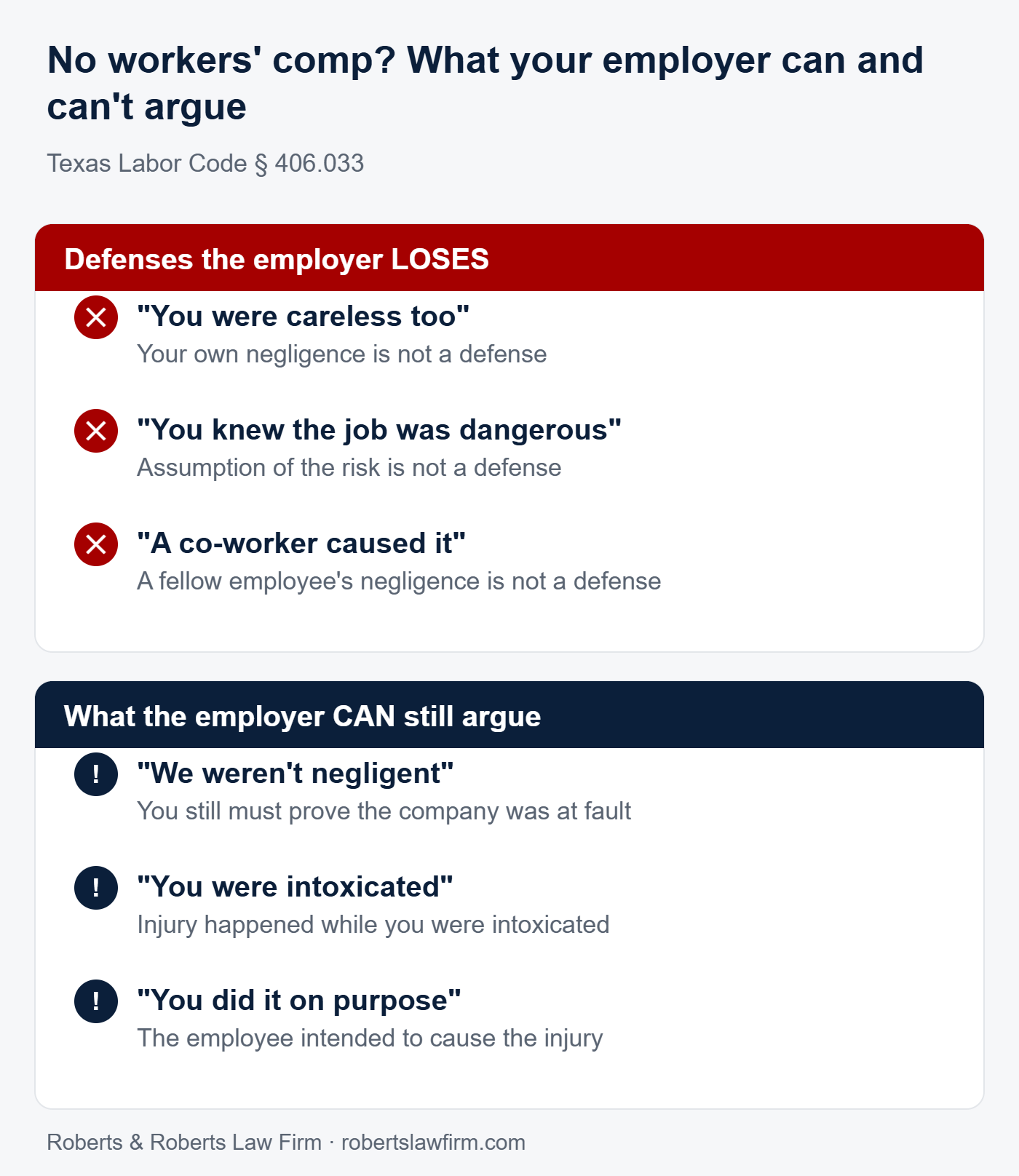
That matters more than it sounds. In a normal Texas injury case, a jury divides up fault, and if you're found more than 50% responsible you recover nothing. Against a non-subscriber, the company can't reduce what it owes by pointing at you. The Texas Supreme Court confirmed this in Kroger Co. v. Keng (2000).
The employer is left with two statutory defenses — that you were intoxicated when you were hurt, or that you meant to hurt yourself — plus the main one: arguing the company simply wasn't negligent.
What counts as employer negligence?
You still have to show the company failed to do something a reasonable employer would do. In our experience the strongest non-subscriber cases involve:
- Equipment that was broken, missing guards, or overdue for repair — and supervisors knew.
- No training, or "training" that was a video and a signature.
- Not enough people for the job: one person lifting what should take two, or a forklift run without a spotter.
- No fall protection, trench shoring, or lockout/tagout on construction and plant jobs.
- Production pressure (being told to skip a safety step to keep the line moving).
- Hiring or keeping an unqualified co-worker or driver.
One caution: Texas courts have said an employer generally doesn't have to warn you about a hazard that's open and obvious or that you already knew about, unless the job required you to face it anyway. How a case is framed matters, which is one reason these claims are harder than they look.
From our files: When an injured worker calls us, one of the first things our intake team does is check whether the employer is on the state's list of workers' comp non-subscribers. Many of these calls involve big retailers and distribution centers that offer a company "injury plan" — and the worker has been told that plan is the same as workers' comp. It isn't.
We've also seen employers dodge the simple question of whether they carry coverage at all, which is why we verify it ourselves. And because a lawsuit can strain a job the client still depends on, we talk through timing with the client before anything is filed.
"Injury benefit plans," arbitration and waivers
Many large non-subscribers — retailers, warehouses, trucking and oilfield service companies — have their own occupational injury plan. These plans may pay some medical bills and wages, but they come with strings:
- Pre-injury waivers are void. Anything you signed when you were hired giving up your right to sue is unenforceable under § 406.033(e).
- Post-injury waivers are strictly limited. A waiver signed after you're hurt only counts if you signed it voluntarily and knowing what it meant, at least 10 business days after you reported the injury, after you'd been seen by a non-emergency doctor, and in a written document that clearly says what you're giving up (§ 406.033(f)).
- Arbitration agreements are often enforceable and can move your case from a jury to an arbitrator. They don't eliminate your claim, but they change strategy.
- Plan deadlines can be very short — some require reporting an injury by the end of the shift.
Before you sign anything from HR or the plan administrator after an injury, have a lawyer read it. A "release" packaged with a benefits check is the most common way injured workers lose valuable claims.
What to do after you're hurt at work
- Report the injury in writing, today, and keep a copy or a photo of it.
- Get medical care and tell the doctor exactly how it happened at work.
- Write down names of everyone who saw it, and what supervisors said afterward.
- Photograph the equipment or area if you can do it safely — it often gets fixed fast.
- Don't give a recorded statement to the company's adjuster before talking to a lawyer.
- Don't sign waivers, releases or "election" forms until they've been reviewed.
What you can recover
Because this is a negligence lawsuit, damages work like any other Texas injury case: medical expenses, past and future lost wages and earning capacity, physical pain, mental anguish, physical impairment and disfigurement. If a worker is killed, the family may bring a wrongful death claim, and Texas allows punitive damages against an employer whose gross negligence caused a death.
Deadlines matter: most claims must be filed within two years. See our guide to the Texas statute of limitations.
Common non-subscriber jobs in East Texas
Non-subscribers show up in every industry, but we see them most often in oilfield services, logging and sawmills, construction subcontractors, manufacturing and distribution, and trucking. Related guides: oilfield accidents, construction accidents, and your rights if you're injured on the job.
Frequently asked questions
Can I be fired for filing a claim against a non-subscriber?
Texas anti-retaliation protections for workers' comp claims apply to employees of subscribing employers. Non-subscriber employees have more limited protections, though some plans and federal laws (like ERISA) may apply. Talk to a lawyer before you file anything if you're worried about your job.
My employer has an injury plan that's paying my bills. Do I still need a lawyer?
Plan benefits are usually far less than what a negligence claim is worth, and accepting them can come with releases or deadlines. A lawyer can tell you whether the plan payments affect your claim.
I was partly at fault. Do I still have a case?
Very possibly. Your own negligence is not a defense for a non-subscriber employer. The question is whether the company was also negligent.
What if my employer is a staffing agency or subcontractor?
Then there may be more than one company involved — the staffing agency, the job site owner, or a general contractor. Each may have different insurance and different defenses.
Hurt working for a company without workers' comp?
Roberts & Roberts has represented injured East Texas workers for 45 years. Your consultation is free, and you pay nothing unless we recover money for you. Call (800) 248-6000 or use the form on this page.
About The Author

- Tex. Labor Code § 406.033 (actions against non-subscribing employers; waivers).
- Texas Department of Insurance, Division of Workers' Compensation, 2024 Biennial Report (non-subscriber estimates).
- Kroger Co. v. Keng, 23 S.W.3d 347 (Tex. 2000).