
Should You Give a Recorded Statement to the Insurance Adjuster?

Within a day or two of a wreck, an adjuster usually calls. They're friendly, they say it's routine, and they ask if they can record the conversation "to get your side of the story."
That recording is evidence. It will be transcribed, studied, and quoted back to you months later. Before you agree, here's what to know about giving a recorded statement to an insurance adjuster.
100% Free Consultation
The short version
- You have no legal obligation to give a recorded statement to the other driver's insurance company.
- Your own policy probably requires you to cooperate, but you can ask to do it with your lawyer present or in writing.
- The questions are designed to lock you in — on fault, on speed, and on how "fine" you felt.
- A polite "not at this time — please put requests in writing" is a complete answer.
Whose adjuster is calling?
| The other driver's insurer | Your own insurer | |
|---|---|---|
| Who they work for | The person who hit you | You (under your policy) |
| Do you have to give a statement? | No | Usually yes — most policies have a cooperation clause |
| Can it be used against you? | Yes, to deny or reduce your claim | Yes, on coverage questions, and it may be shared in litigation |
| Best approach | Decline politely; let your lawyer communicate | Cooperate, but on your terms — lawyer present, facts only |
Why adjusters want it on tape
Insurance adjusters are well-trained at finding ways to avoid liability for their company, and they're good at their jobs. A recorded statement helps them in three ways:
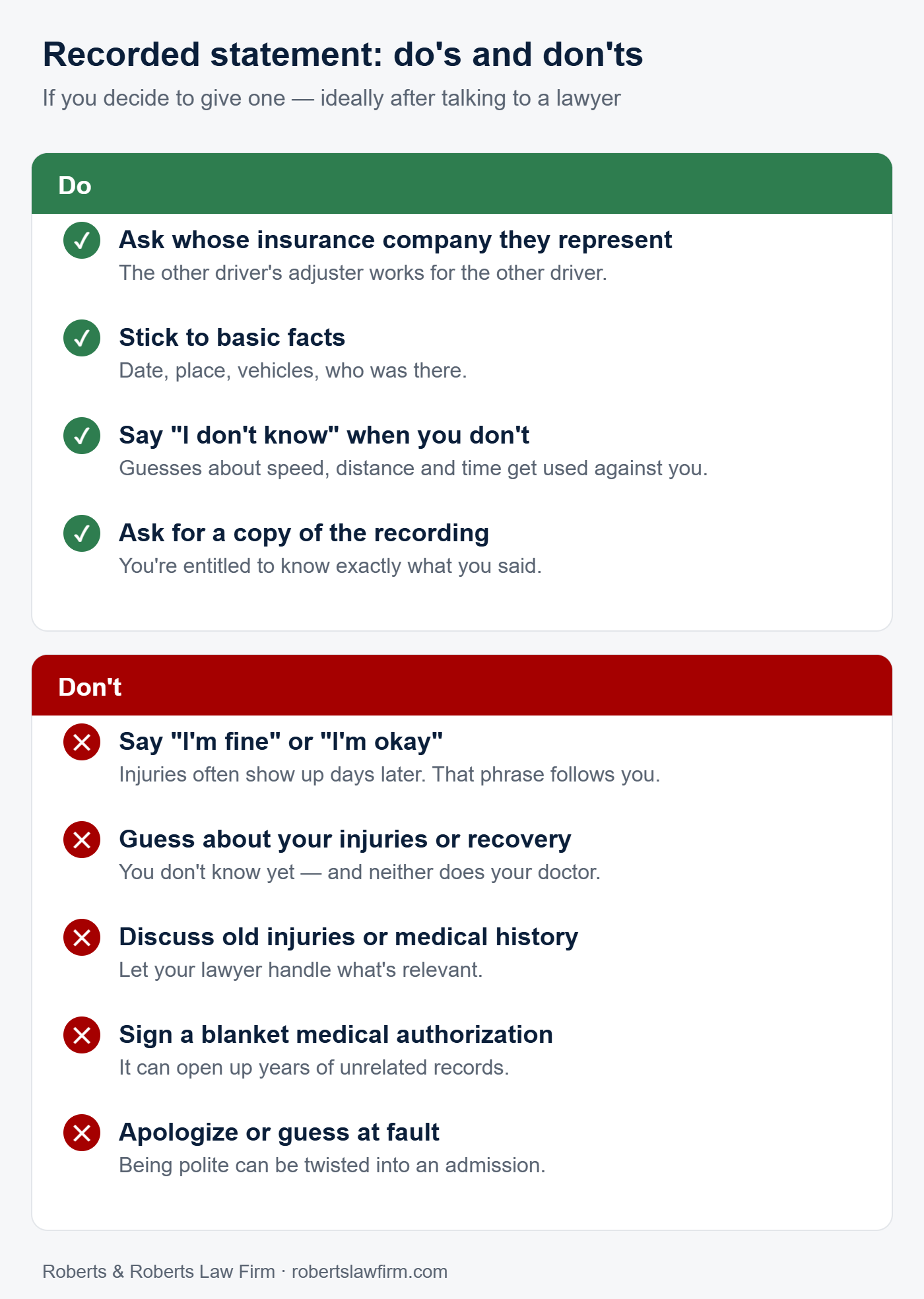
- Fault. "Did you see the other car before impact?" "How fast were you going?" Any estimate can be used to shift blame under Texas's comparative fault rules.
- Injuries. "How are you feeling today?" If you say "pretty good," that's in the file, even if an MRI two weeks later shows a herniated disc.
- Medical history. Questions about past injuries open the door to arguing your pain is from something else.
What to say when the adjuster calls
You don't need to be rude, and you don't need to explain yourself. Something like this works:
"Thanks for calling. I'm not going to give a recorded statement right now. I'm still getting medical care. Please send anything you need in writing — or, if I have a lawyer, I'll have them contact you."
Then write down the adjuster's name, company, phone number and claim number. It's fine to confirm basic facts like your name and contact information and that a crash happened.
If your own insurance company asks
Your policy likely requires you to cooperate with your insurer's investigation, especially for PIP or uninsured motorist claims. Refusing outright can create coverage problems. But cooperation has limits — you can ask to schedule it, have your lawyer on the line, review your crash report first, and stick to facts you actually know.
From our files: It isn't only the other driver's insurer that asks. When our clients make an uninsured or underinsured motorist claim, their own insurance company often sends a letter asking to take a recorded statement of "our insured."
Because the client's policy may require cooperation, we don't simply refuse. We schedule it, prepare the client, and the attorney is in the room with our client. On the other hand, the at-fault driver's adjuster gets a different answer: our clients will not be giving the adjuster a recorded statement at all.
The medical authorization trap
Adjusters often mail a medical authorization along with the request for a statement. A blanket authorization can let them pull years of unrelated records looking for a pre-existing condition to blame for your injuries. When you hire a lawyer, however, the lawyer will provide only the records that relate to the crash instead.
Frequently asked questions
Can the insurance company deny my claim if I refuse a recorded statement?
The other driver's insurer can't make a statement a legal requirement for your claim, though they may say they "can't evaluate" it without one. Your own insurer may have more leverage under your policy's cooperation clause.
I already gave a recorded statement. Is my case ruined?
Usually not. Ask for a copy, and tell your lawyer what you said. Most statements can be put in context with medical records and other evidence.
Can they record me without telling me?
Texas is a one-party consent state for recording phone calls, so a participant can generally record. Reputable adjusters will tell you they're recording, but assume every call is.
Should I give a written statement instead?
A written statement has the same risks, without the back-and-forth. Have your lawyer review or prepare it.
An adjuster already calling?
Let us handle the insurance companies while you focus on getting better. Free consultation; no fee unless we recover. Call (800) 248-6000.
About The Author

- Texas Department of Insurance, consumer guidance on auto claims.
- Tex. Penal Code § 16.02 (one-party consent to recording).
- Tex. Civ. Prac. & Rem. Code ch. 33 (proportionate responsibility).